
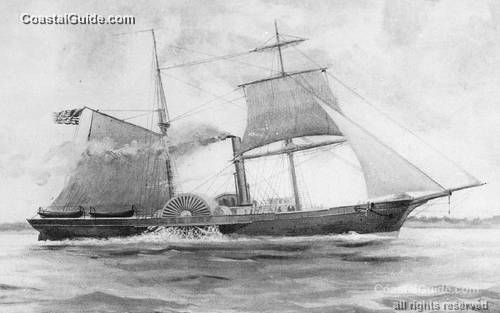
USS Harriet Lane, a 750-ton side-wheel gunboat, was built at New York City in 1857 as the U.S. Revenue Cutter Harriet Lane. In addition to carrying out her Revenue Service duties, she served with the Navy during the Paraguay expedition of 1858-59.
Harriet Lane was again transferred to the Navy 30 March 1861 for service in the expedition sent to Charleston Harbor, S.C., to supply the Fort Sumter garrison. She departed New York 8 April and arrived off Charleston 11 April. The next day she fired a shot across the bow of Nashville when that merchantman appeared with no colors flying. Nashville avoided further attack by promptly hoisting the United States ensign, but 2 days later raised the Palmetto flag to begin her career as one of the most elusive Confederate privateers. When Major Anderson surrendered Fort Sumpter 13 April, Harriet Lane withdrew with her sister ships. While so engaged, on 12 April 1861, she fired the first U.S. Navy shot of the Civil War.
Her next important service came the following summer when a task force was sent against Fort Clark and Fort Hatteras on the Outer Banks of North Carolina to check blockade running in the area. The ships sortied from Hampton Roads 26 August 1861 for this first important combined amphibious operation of the war. The next morning Harriet Lane, Monticello, and Pawnee slipped close inshore to provide direct support to the landings while heavier ships pounded the forts from deeper water. The last resistance was snuffed out the following afternoon, giving a badly needed boost to morale in the North disheartened a month before by defeat in the first battle of Bull Run. Of greater importance was the fact that this combined operation opened the inland waterways to Union ships and gave the North Atlantic Blockading Squadron a base deep in Southern waters.
Harriet Lane ran aground while attempting to enter Pamlico Sound through Hatteras Inlet 29 August and suffered severe damage while fast on the shoal. She was refloated at the cost of her armament, rigging, stores, provisions, and everything else on board which could be heaved over the side to lighten ship. Temporary repairs completed 3 September, she proceeded to Hampton Roads, arriving 8 September 1861.
In early June 1861, Harriet Lane exchanged fire with an enemy battery near Newport News, Virginia, and in late August participated in the Navy's initial major combat operation, the capture of Forts Hatteras and Clark at Hatteras Inlet, North Carolina. She was formally transferred from the Revenue Cutter Service to the Navy in September. Also during 1861, Harriet Lane captured four prizes while enforcing the blockade and, in December, fired on Confederate positions at Freestone Point, Virginia.
Harriet Lane was sent to the Gulf of Mexico in February 1862 to serve as flagship of Commander David Dixon Porter's fleet of mortar schooners. While en route, she engaged Confederate artillery at Shipping Point, Virginia, and captured a sailing vessel off the Florida coast. During March and April, Porter's mortar flotilla played an important part in the operations that led to the capture of New Orleans. Harriet Lane accompanied this force at that time, and during some of its subsequent activities on the Mississippi River below Vicksburg. In May 1862, she also assisted in the occupation of fortifications at Pensacola, Florida.
After serving on the blockade off Mobile, Alabama, Harriet Lane participated in the early October 1862 capture of Galveston, Texas. She remained in the Galveston area and, on 1 January 1863, while inside Galveston Bay, she was boarded and captured by Confederate troops operating from the steamers Bayou City and Neptune. Following this bold action, which resulted in the recovery of Galveston by Southern forces, Harriet Lane was employed by the Confederate Army in Texas waters. In about early 1864, she was sold and converted to a blockade runner. Renamed Lavina, she left Galveston in late April and went to Havana, Cuba. Interned there through the end of the Civil War, she subsequently became the sailing merchant vessel Elliot Richie and remained in commercial service until May 1884, when she was lost off Pernambuco, Brazil.

You haven’t experienced North Carolina until you’ve experienced North Carolina BBQ, and Pigman’s Bar-B-Que offers excellent North Carolina BBQ meals served with southern hospitality. Pigman’s offers traditional eastern...

Check out Corolla's newest 5-star attraction! Pirate-Themed 18-Hole Minature Golf Course and Arcade with waterfalls, a pirate ship, caves, skulls, and more! So much fun for the whole family! Come...

Sun Realty offers the Best Selection of Vacation Rentals on the Outer Banks. Our large selection of Outer Banks rentals means you can choose from a wide range of amenities, including private swimming pools, hot tubs, theater rooms, game rooms, pet...
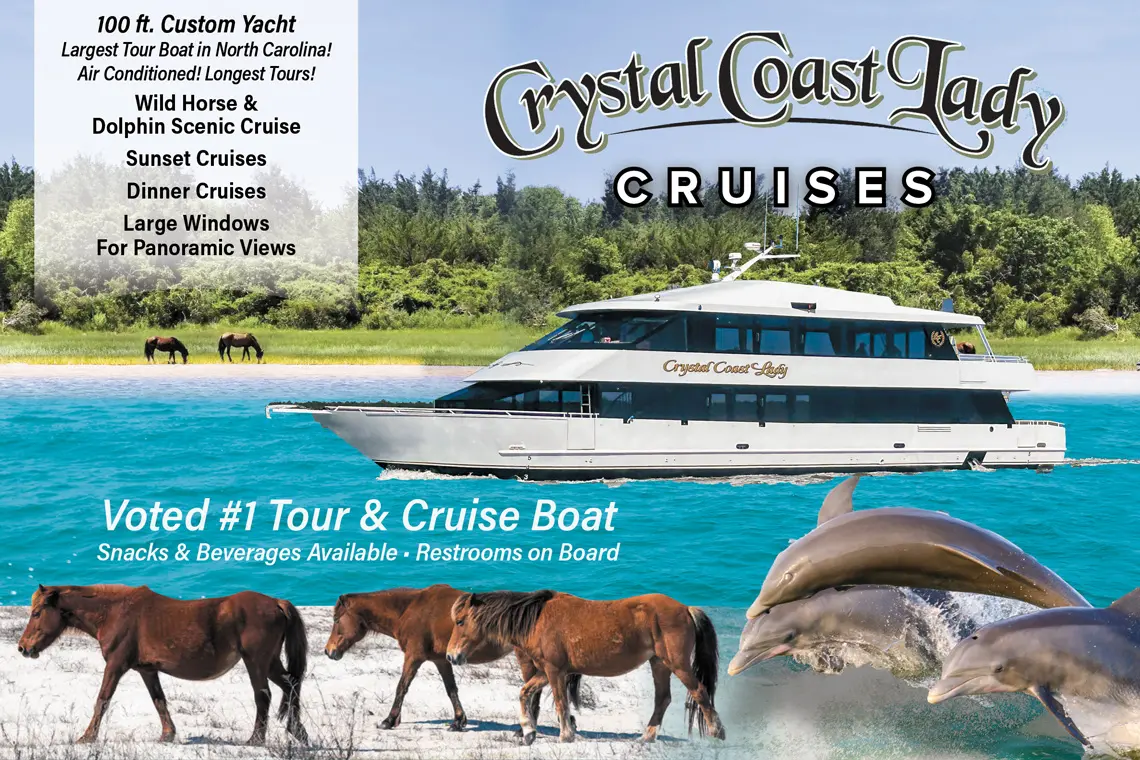
Crystal Coast Lady Cruises is a 100 ft. custom yacht that can effortlessly provide a number of family-friendly expeditions to vacationers who want to enjoy this delicate chain of barrier islands and coastal territory to its fullest. Based out of...